Your business is losing jobs to slow response. Here is how to fix it.
78% of customers buy from the first business that responds to their enquiry, and the average service business takes 47 hours to reply. That gap is where competitors are winning jobs you never knew you lost.
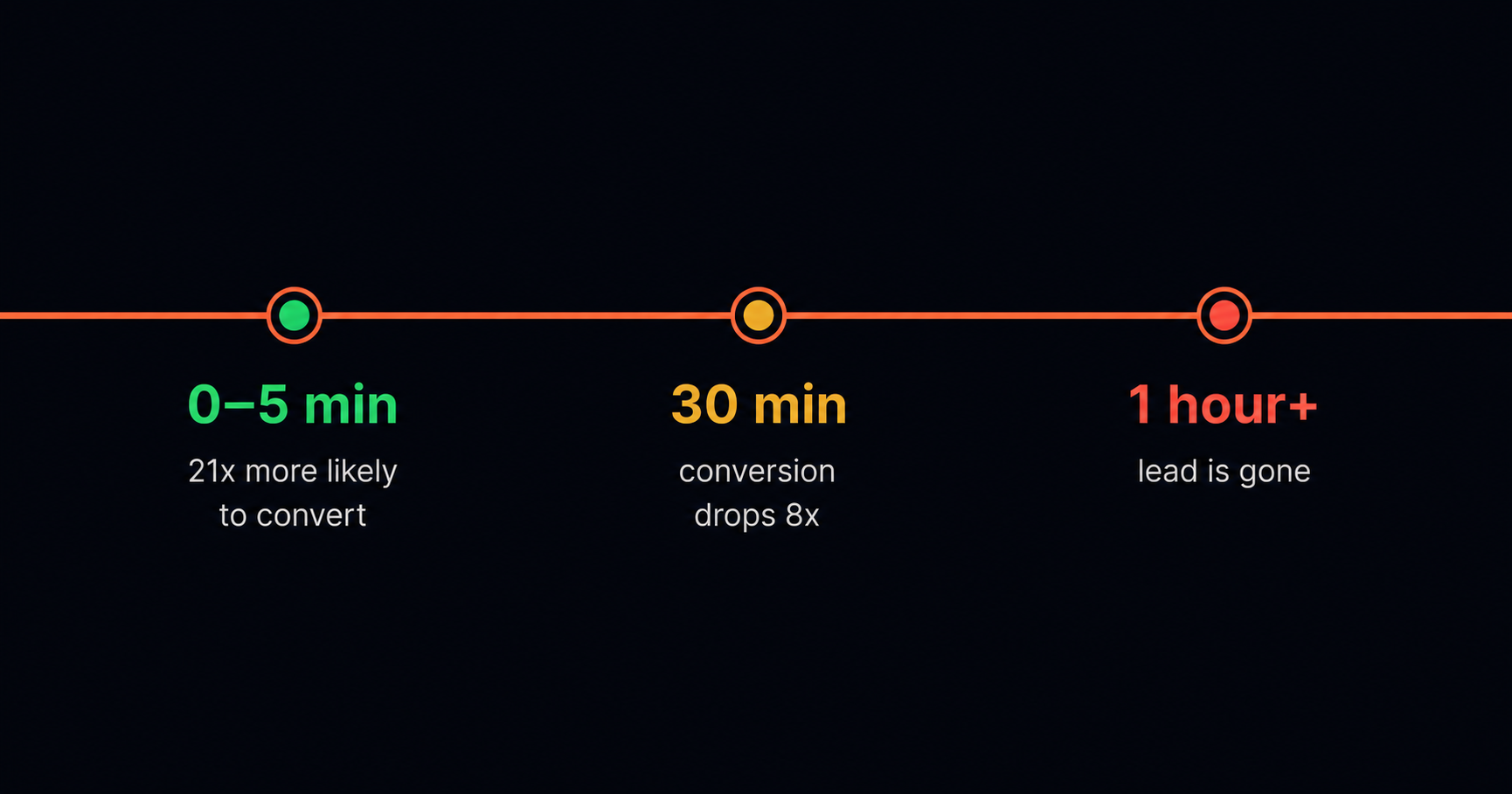
This is the speed to lead problem, and it affects every service business that wins work through enquiries: removalists, plumbers, solar installers, real estate agents. The job usually goes to whoever responds first, not whoever quotes best.
What is speed to lead?
Speed to lead is the time between a new enquiry arriving and your business sending its first response.
A customer submits a web form at 9pm on a Tuesday, a competitor calls them at 9:02pm, and you see the enquiry the next morning. The customer has already booked, and you never had a chance to quote.
The research on this is consistent: businesses that respond within 5 minutes are 21 times more likely to convert a lead compared to those that wait 30 minutes, responding within 60 seconds lifts conversion rates by 391%, and after one hour without a reply, the chance of a meaningful conversation drops by 10 times.
Most owner-operated service businesses are nowhere near the 5-minute mark, because they are on site, in a meeting, or finished for the day when the enquiry comes in.
Why most service businesses fail this test
The problem is not effort, because most service business owners work long hours and genuinely want to respond quickly. The problem is structure: there is no system catching enquiries and acting on them the moment they arrive.
A removals enquiry arrives at 8pm while the owner is at dinner, a solar enquiry comes in on Saturday morning while the crew is on a roof, and a plumbing call lands at 2pm while the tradesperson is under a sink.
The average response time across the industry is 47 hours, nearly two full days, not because owners do not care but because no one is available to respond the moment a lead arrives.
Customers submitting enquiries are usually comparing 2 to 3 businesses at the same time, and the first reply wins the conversation. By the time you follow up, the job is gone.
For a business receiving 40 enquiries per month with an average job value of $2,000, the difference between a 12% close rate and a 25% close rate is 5 extra jobs per month, which is $10,000 per month in revenue sitting on the other side of a faster response.
What the 5-minute window actually means for your revenue
Five minutes is not an arbitrary benchmark, it reflects how quickly buyers move on.
When a customer submits an enquiry, they are in a decision-making moment, and they want a response before they move to the next tab or call the next business on Google. That window is 5 minutes or less.
Research shows that conversion likelihood drops 8 times the moment a lead has to wait more than 5 minutes, and after 30 minutes you are 21 times less likely to qualify that lead compared to a business that responded in the first 5 minutes. After an hour, the drop-off is 10 times.
For trades and service businesses, the maths is blunt: 55% of businesses take more than 5 days to respond to a new enquiry, so if your competitor responds in 5 minutes and you respond the next morning, the competitor wins that job every time, even if your price is lower.
The 5-minute window is not about technology, it is about being present in the moment a customer decides. A system that responds instantly means you are always present, even when you are on the tools.
What a fixed system looks like
A removals business in Adelaide had this problem, where enquiries came through a web form, the owner would see them the next morning or after a long day on the road, and by then customers had often already booked someone else.
The fix was a system that runs without the owner needing to be at a desk.
A customer fills in the form at any hour and within 90 seconds they receive a personalised SMS and email that references their move date, their suburb, and the details they submitted. It reads like someone at the business took the time to write it, and simultaneously the owner receives an alert with the lead's name, move details, and contact number.
The owner did not change how they run the business and did not hire extra staff. The system catches every enquiry the moment it arrives, sends the customer an immediate reply, and puts the lead in front of the owner with everything they need to follow up.
The result: zero missed leads, with every enquiry getting a response in under 90 seconds, including enquiries that arrive at 11pm on a Friday.
FAQ
How fast should a business respond to a lead?
A service business should aim to respond within 5 minutes, with under 60 seconds as the goal. Research shows that 78% of customers buy from the first business to respond, and after 5 minutes the chance of converting a lead drops 8 times. For most owner-operated businesses, hitting that consistently requires a system, not manual effort.
What is a good lead response time for a small business?
Under 5 minutes is good and under 60 seconds is excellent. Most small businesses currently average 47 hours, nearly two full days. That is not unusual, but it is expensive, because every hour of delay reduces the chance of converting that lead.
Can I fix slow lead response without hiring extra staff?
Yes. The fix is not more people, it is a system that responds the moment an enquiry arrives, regardless of what the team is doing. Staff handle the follow-up conversation and the system handles the 90-second window.
Does this work for after-hours and weekend enquiries?
That is exactly when it matters most. Enquiries that arrive after business hours are the ones most likely to go cold by morning, so a system that responds at 10pm converts those leads where a business that replies at 9am the next day usually does not.
How much does a lead response system cost?
It depends on what the system has to do, so the honest answer is that it is scoped in a short call rather than quoted off a page. The more useful question is what slow response is already costing. For a business receiving 40 enquiries per month at $2,000 per job, closing 5 more jobs per month pays for the system in the first week.